Caffeを使って画像を判別してみた。確率88.8%で飛行機

選んだ画像

画像判別手順詳細 airplanes 799 88.8

判別結果 88.8%の確率で飛行機

chibi@1604:~/caffe$ python show_result.py data/ilsvrc12/synset_words.txt result.npy
#1 | n02690373 airliner | 88.8%
#2 | n04266014 space shuttle | 7.2%
#3 | n04592741 wing | 2.5%
chibi@1604:~/caffe$

カテゴリー: nvidia, ubuntu | コメントする

Fedora release 31 Kernel5.5.8-200.fc31.x86_64 Update

Fedora release 31 Kernelが5.5.8-200.fc31.x86_64にUpdateされました。

[root@f31 ~]# uname -r
5.5.8-200.fc31.x86_64
[root@f31 ~]# php -v
PHP 7.4.3 (cli) (built: Feb 18 2020 11:53:05) ( NTS )
Copyright (c) The PHP Group
Zend Engine v3.4.0, Copyright (c) Zend Technologies
[root@f31 ~]# curl -V
curl 7.66.0 (x86_64-redhat-linux-gnu) libcurl/7.66.0 OpenSSL/1.1.1d-fips zlib/1.2.11 brotli/1.0.7 libidn2/2.3.0 libpsl/0.21.0 (+libidn2/2.2.0) libssh/0.9.3/openssl/zlib nghttp2/1.40.0
Release-Date: 2019-09-11
Protocols: dict file ftp ftps gopher http https imap imaps ldap ldaps pop3 pop3s rtsp scp sftp smb smbs smtp smtps telnet tftp
Features: AsynchDNS brotli GSS-API HTTP2 HTTPS-proxy IDN IPv6 Kerberos Largefile libz Metalink NTLM NTLM_WB PSL SPNEGO SSL TLS-SRP UnixSockets
[root@f31 ~]# samba -V
Version 4.11.6
[root@f31 ~]# cat /etc/redhat-release
Fedora release 31 (Thirty One)
[root@f31 ~]#

カテゴリー: fedora | コメントする

Fedora release 30 Kernel5.5.8-100.fc30.x86_64 Update

Fedora release 30 Kernelが5.5.8-100.fc30.x86_64にUpdateされました。

[root@f30 ~]# uname -r
5.5.8-100.fc30.x86_64
[root@f30 ~]# php -v
PHP 7.4.3 (cli) (built: Feb 18 2020 11:53:05) ( NTS )
Copyright (c) The PHP Group
Zend Engine v3.4.0, Copyright (c) Zend Technologies
with Zend OPcache v7.4.3, Copyright (c), by Zend Technologies
[root@f30 ~]# curl -V
curl 7.65.3 (x86_64-redhat-linux-gnu) libcurl/7.65.3 OpenSSL/1.1.1d-fips zlib/1.2.11 brotli/1.0.7 libidn2/2.3.0 libpsl/0.20.2 (+libidn2/2.0.5) libssh/0.9.3/openssl/zlib nghttp2/1.40.0
Release-Date: 2019-07-19
Protocols: dict file ftp ftps gopher http https imap imaps ldap ldaps pop3 pop3s rtsp scp sftp smb smbs smtp smtps telnet tftp
Features: AsynchDNS brotli GSS-API HTTP2 HTTPS-proxy IDN IPv6 Kerberos Largefile libz Metalink NTLM NTLM_WB PSL SPNEGO SSL TLS-SRP UnixSockets
[root@f30 ~]# samba -V
Version 4.10.13
[root@f30 ~]# cat /etc/redhat-release
Fedora release 30 (Thirty)
[root@f30 ~]#

カテゴリー: fedora | コメントする

Ubuntu16.04.6 TITAN V x2 CUDA 10.2 Samples nbodybenchmark を動作させてみたTITaN V x2 単精度=12572.154 GFLOP/s TITAN V x2 倍精度=5477.201 GFLOP/s

chibi@1604:~/NVIDIA_CUDA-10.2_Samples/5_Simulations/nbody$ cat /etc/os-release
NAME=”Ubuntu”
VERSION=”16.04.6 LTS (Xenial Xerus)”
ID=ubuntu
ID_LIKE=debian
PRETTY_NAME=”Ubuntu 16.04.6 LTS”
VERSION_ID=”16.04″
HOME_URL=”http://www.ubuntu.com/”
SUPPORT_URL=”http://help.ubuntu.com/”
BUG_REPORT_URL=”http://bugs.launchpad.net/ubuntu/”
VERSION_CODENAME=xenial
UBUNTU_CODENAME=xenial
chibi@1604:~/NVIDIA_CUDA-10.2_Samples/5_Simulations/nbody$ nvcc -V
nvcc: NVIDIA (R) Cuda compiler driver
Copyright (c) 2005-2019 NVIDIA Corporation
Built on Wed_Oct_23_19:24:38_PDT_2019
Cuda compilation tools, release 10.2, V10.2.89
chibi@1604:~/NVIDIA_CUDA-10.2_Samples/5_Simulations/nbody$ ./nbody –benchmark –
-numbodies=256000 -numdevices=2
Run “nbody -benchmark [-numbodies=<numBodies>]” to measure performance.
-fullscreen (run n-body simulation in fullscreen mode)
-fp64 (use double precision floating point values for simulation)
-hostmem (stores simulation data in host memory)
-benchmark (run benchmark to measure performance)
-numbodies=<N> (number of bodies (>= 1) to run in simulation)
-device=<d> (where d=0,1,2…. for the CUDA device to use)
-numdevices=<i> (where i=(number of CUDA devices > 0) to use for simulation)
-compare (compares simulation results running once on the default GPU and once on the CPU)
-cpu (run n-body simulation on the CPU)
-tipsy=<file.bin> (load a tipsy model file for simulation)

NOTE: The CUDA Samples are not meant for performance measurements. Results may vary when GPU Boost is enabled.

number of CUDA devices = 2
> Windowed mode
> Simulation data stored in system memory
> Single precision floating point simulation
> 2 Devices used for simulation
GPU Device 0: “Volta” with compute capability 7.0

> Compute 7.0 CUDA device: [TITAN V]
number of bodies = 256000
256000 bodies, total time for 10 iterations: 1042.558 ms
= 628.608 billion interactions per second
= 12572.154 single-precision GFLOP/s at 20 flops per interaction
chibi@1604:~/NVIDIA_CUDA-10.2_Samples/5_Simulations/nbody$ ./nbody -fp64 –bench
mark –numbodies=256000 -numdevices=2
Run “nbody -benchmark [-numbodies=<numBodies>]” to measure performance.
-fullscreen (run n-body simulation in fullscreen mode)
-fp64 (use double precision floating point values for simulation)
-hostmem (stores simulation data in host memory)
-benchmark (run benchmark to measure performance)
-numbodies=<N> (number of bodies (>= 1) to run in simulation)
-device=<d> (where d=0,1,2…. for the CUDA device to use)
-numdevices=<i> (where i=(number of CUDA devices > 0) to use for simulation)
-compare (compares simulation results running once on the default GPU and once on the CPU)
-cpu (run n-body simulation on the CPU)
-tipsy=<file.bin> (load a tipsy model file for simulation)

NOTE: The CUDA Samples are not meant for performance measurements. Results may vary when GPU Boost is enabled.

number of CUDA devices = 2
> Windowed mode
> Simulation data stored in system memory
> Double precision floating point simulation
> 2 Devices used for simulation
GPU Device 0: “Volta” with compute capability 7.0

Compute 7.0 CUDA device: [TITAN V]
> Compute 7.0 CUDA device: [TITAN V]
number of bodies = 256000
256000 bodies, total time for 10 iterations: 3589.571 ms
= 182.573 billion interactions per second
= 5477.201 double-precision GFLOP/s at 30 flops per interaction
chibi@1604:~/NVIDIA_CUDA-10.2_Samples/5_Simulations/nbody$
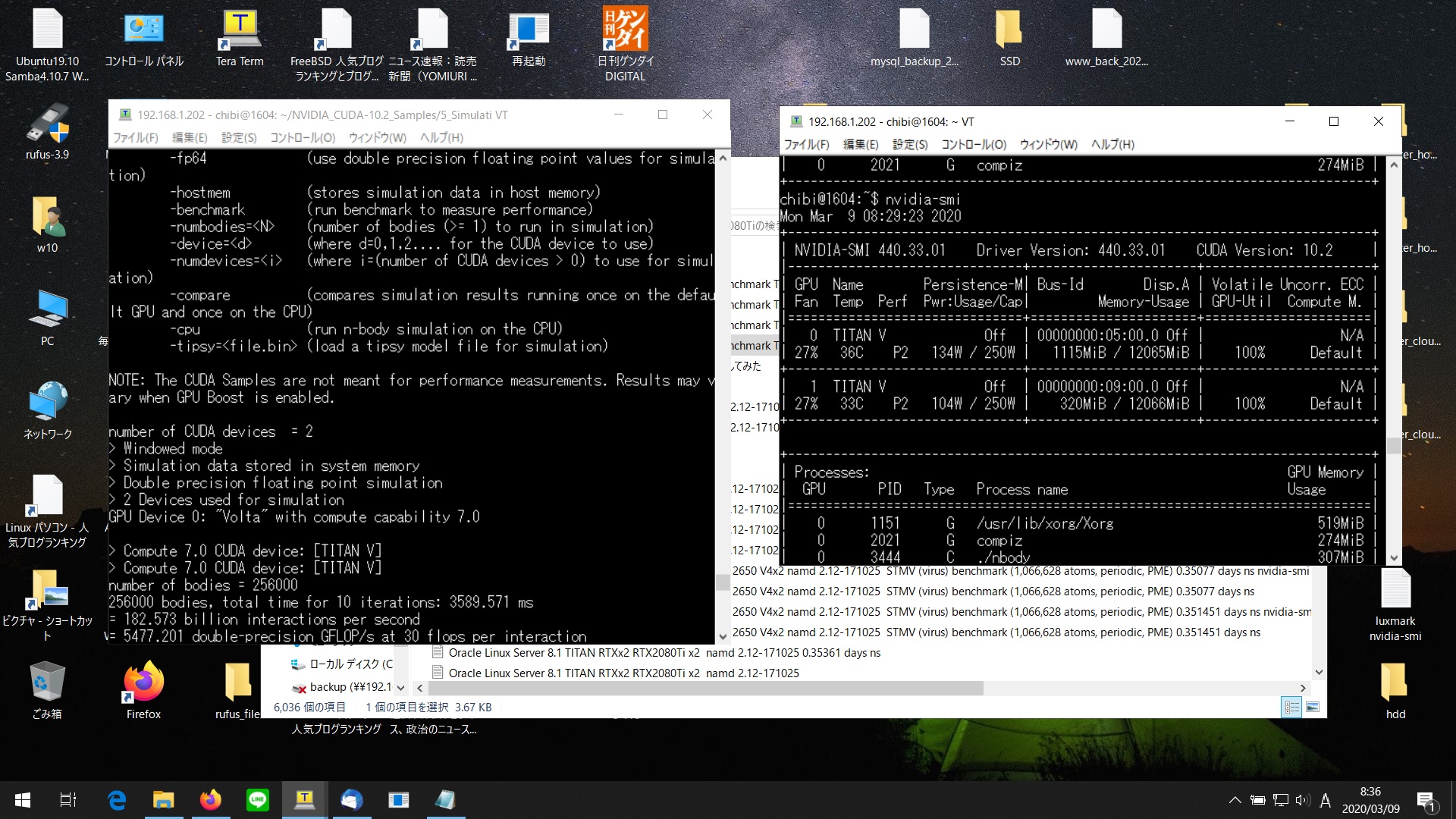
GPU温度推移 Ubuntu16.04.6 TITAN V x2 CUDA 10.2 Samples nbodybenchmark TITaN V x2 単精度=12572.154 GFLOP s TITAN V x2 倍精度=5477.201 GFLOP s nvidia-smi


カテゴリー: nvidia, ubuntu | コメントする

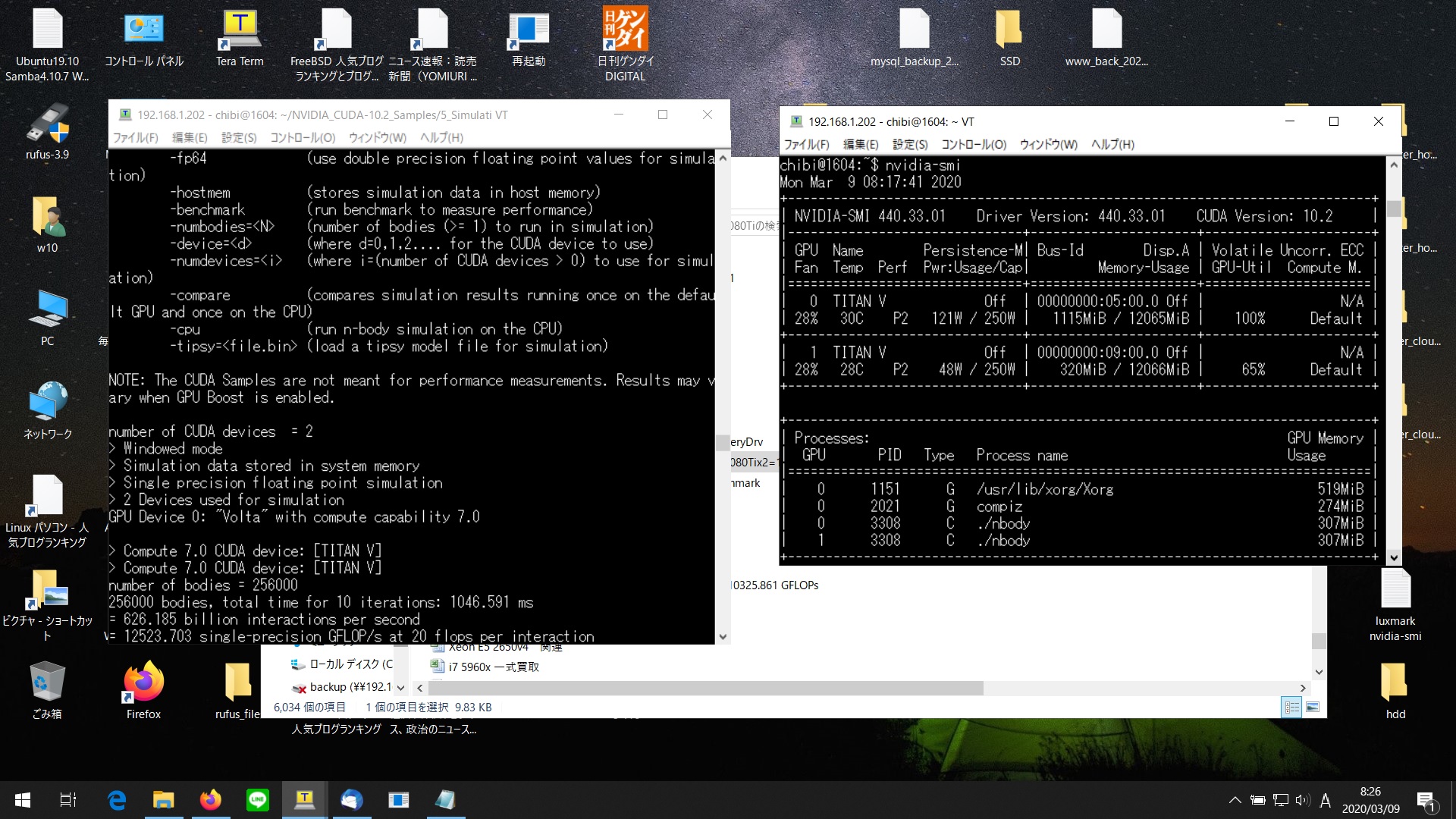
Ubuntu16.04.6 TITAN V x2 CUDA 10.2 Samples nbodybenchmark を動作させてみたTITaN V x2=12523.703 GFLOP/s TITAN V x1=8164.031 GFLOP/s

chibi@1604:~/NVIDIA_CUDA-10.2_Samples/5_Simulations/nbody$ cat /etc/os-release
NAME=”Ubuntu”
VERSION=”16.04.6 LTS (Xenial Xerus)”
ID=ubuntu
ID_LIKE=debian
PRETTY_NAME=”Ubuntu 16.04.6 LTS”
VERSION_ID=”16.04″
HOME_URL=”http://www.ubuntu.com/”
SUPPORT_URL=”http://help.ubuntu.com/”
BUG_REPORT_URL=”http://bugs.launchpad.net/ubuntu/”
VERSION_CODENAME=xenial
UBUNTU_CODENAME=xenial
chibi@1604:~/NVIDIA_CUDA-10.2_Samples/5_Simulations/nbody$ nvcc -V
nvcc: NVIDIA (R) Cuda compiler driver
Copyright (c) 2005-2019 NVIDIA Corporation
Built on Wed_Oct_23_19:24:38_PDT_2019
Cuda compilation tools, release 10.2, V10.2.89
chibi@1604:~/NVIDIA_CUDA-10.2_Samples/5_Simulations/nbody$ ./nbody –benchmark –numbodies=256000 -numdevices=2
Run “nbody -benchmark [-numbodies=<numBodies>]” to measure performance.
-fullscreen (run n-body simulation in fullscreen mode)
-fp64 (use double precision floating point values for simulation)
-hostmem (stores simulation data in host memory)
-benchmark (run benchmark to measure performance)
-numbodies=<N> (number of bodies (>= 1) to run in simulation)
-device=<d> (where d=0,1,2…. for the CUDA device to use)
-numdevices=<i> (where i=(number of CUDA devices > 0) to use for simulation)
-compare (compares simulation results running once on the default GPU and once on the CPU)
-cpu (run n-body simulation on the CPU)
-tipsy=<file.bin> (load a tipsy model file for simulation)

NOTE: The CUDA Samples are not meant for performance measurements. Results may vary when GPU Boost is enabled.

number of CUDA devices = 2
> Windowed mode
> Simulation data stored in system memory
> Single precision floating point simulation
> 2 Devices used for simulation
GPU Device 0: “Volta” with compute capability 7.0

> Compute 7.0 CUDA device: [TITAN V]
number of bodies = 256000
256000 bodies, total time for 10 iterations: 1046.591 ms
= 626.185 billion interactions per second
= 12523.703 single-precision GFLOP/s at 20 flops per interaction
chibi@1604:~/NVIDIA_CUDA-10.2_Samples/5_Simulations/nbody$ ./nbody –benchmark –numbodies=256000 -numdevices=1
Run “nbody -benchmark [-numbodies=<numBodies>]” to measure performance.
-fullscreen (run n-body simulation in fullscreen mode)
-fp64 (use double precision floating point values for simulation)
-hostmem (stores simulation data in host memory)
-benchmark (run benchmark to measure performance)
-numbodies=<N> (number of bodies (>= 1) to run in simulation)
-device=<d> (where d=0,1,2…. for the CUDA device to use)
-numdevices=<i> (where i=(number of CUDA devices > 0) to use for simulation)
-compare (compares simulation results running once on the default GPU and once on the CPU)
-cpu (run n-body simulation on the CPU)
-tipsy=<file.bin> (load a tipsy model file for simulation)

NOTE: The CUDA Samples are not meant for performance measurements. Results may vary when GPU Boost is enabled.

number of CUDA devices = 1
> Windowed mode
> Simulation data stored in video memory
> Single precision floating point simulation
> 1 Devices used for simulation
GPU Device 0: “Volta” with compute capability 7.0

Compute 7.0 CUDA device: [TITAN V]
number of bodies = 256000
256000 bodies, total time for 10 iterations: 1605.481 ms
= 408.202 billion interactions per second
= 8164.031 single-precision GFLOP/s at 20 flops per interaction
chibi@1604:~/NVIDIA_CUDA-10.2_Samples/5_Simulations/nbody$

GPU温度推移 Ubuntu16.04.6 TITAN V x2 CUDA 10.2 Samples nbodybenchmark TITaN V x2=12523.703 GFLOP s TITAN V x1=8164.031 GFLOP s nvidia-smi

カテゴリー: nvidia, ubuntu | コメントする